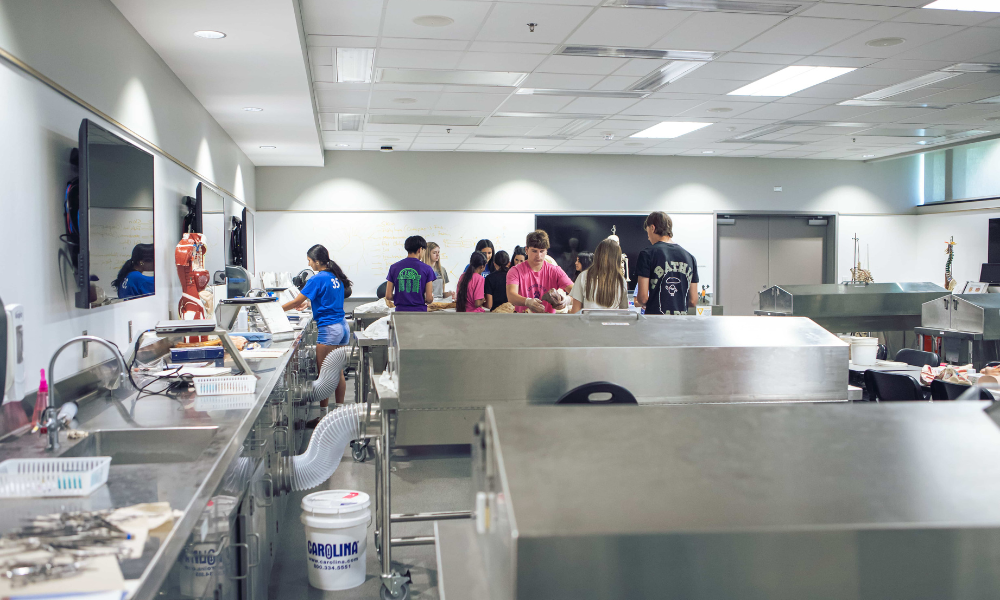
Tucked Inside the state-of-the-art Bishop Gerber Science Center at Newman University is a rare gem for a university of its size: a fully equipped cadaver lab. While such facilities are typically found only at large medical schools, Newman not only maintains one—it shares it with KU School of Medicine in Wichita, and opens it to visiting high school students.
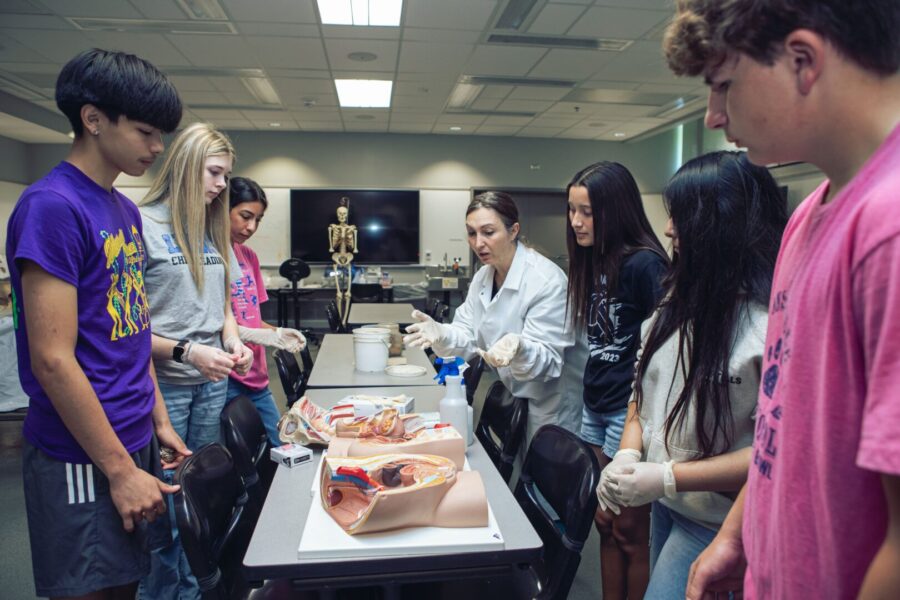
Cristina Dieni, assistant professor of biology, has taken up the mantle from retired professor Dr. Osbourn, who spent over two decades guiding students through hands-on anatomy education. Dieni continues the tradition, offering tours of the cadaver lab to high school students and now to Newman undergraduates as well. “I became inspired by Dr. Osbourn’s outreach,” said Dieni. “This is a fantastic chance for high school kids to see and feel for themselves whether a career in medicine or related fields is what they want.”
The tours are far more than a curiosity. They are an immersive learning experiences that leave a lasting impression. “Touching a real organ activates the brain in a multisensory way—texture, weight, temperature—that improves comprehension and fosters emotional and professional connections,” Dieni explained. “That’s something books or plastic models just can’t replicate.” The reaction from high school visitors has been overwhelmingly positive. “They’re curious, engaged, and ask great questions,” Dieni said. “I’ve been so impressed by their level of preparation.”
Newman’s cadaver lab is no ordinary classroom. Housed within the $22 million Bishop Gerber Science Center, it features eight downdraft tables to ensure safe ventilation during dissections.
The facility is advanced enough to serve KU Med students, a point of pride for the university. “We’re honored to support KU in training the next generation of doctors,” said Ryan Huschka, director of science outreach. “It speaks volumes about the quality of our program and facilities.”
Tours are coordinated with local high school science teachers, who prepare students for the emotional and academic impact of the experience. “It’s rare that a student gets overwhelmed,” Huschka noted, “but we’re always ready to support them if they do.”
The impact of these visits lasts well beyond the lab. Many students later cite their tour as a deciding factor in pursuing health sciences—and in choosing Newman. As Dieni prepares for her next tour on May 9, she hopes to expand opportunities for students to learn from this invaluable resource. “This lab brings science to life,” she said. “And that can change lives.”