On this episode of “The Newman Bond” podcast, Newman University Associate Professor of Philosophy John Brungardt, Ph.D., discusses his recently published book, “Natural Philosophy: An Introduction.”
The book started as an article published in May 2025 for the recently founded Encyclopedia of Catholic Theology. It offers a look at how natural philosophy reveals deeper connections between humanity, the cosmos and divine order.
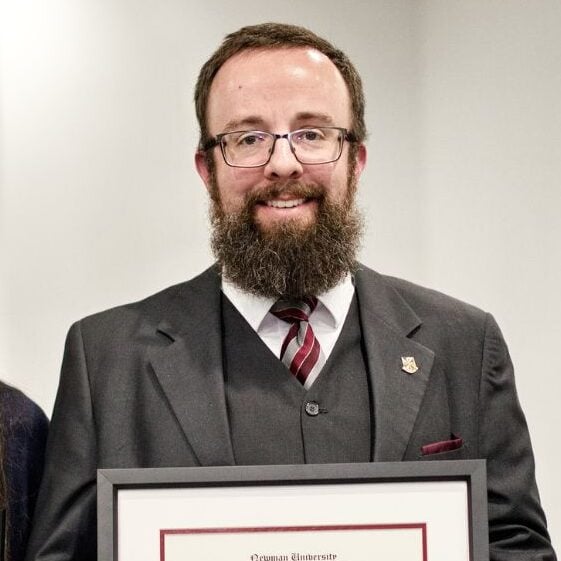
Brungardt, who works closely with the seminarians at Newman, said the publication grew directly out of material he teaches in his courses.
“It’s a topic that bridges science and philosophy — and invites students to think about creation in a unified, meaningful way,” he said.
Overview of conversation topics
Read on to skim or find timestamps of specific topics covered in this episode.

Discovering a passion for philosophy (00:00–01:30)
Brungardt discusses his background — growing up as the oldest of 10, homeschooled and initially interested in filmmaking before discovering philosophy at Thomas Aquinas College through its Great Books program.
Academic journey and global study (01:35–03:45)
He explains how conflicting ideas in philosophy and science during his undergraduate studies sparked his pursuit of graduate work at the Catholic University of America, followed by a research post in Chile before joining Newman.
The influence of great thinkers (04:44–06:20)
Brungardt describes how reading Newton and Kant during college shaped his critical thinking; Aristotle’s writings grounded his philosophical approach, inspiring his continued interest in resolving philosophical and scientific tensions.
Teaching philosophy through deep reading (06:45–08:36)
Teaching at Newman, he values the chance to lead deep, patient readings of works like “Grammar of Assent” by St. John Henry Newman, helping students develop intellectual patience and deeper insight.
Guiding seminarians toward theological understanding (09:10–11:43)
Working with seminarians, he helps them see how philosophy strengthens theological understanding. Though some initially view philosophy as a detour, he shows how courses like Natural Theology prepare them for major seminary.
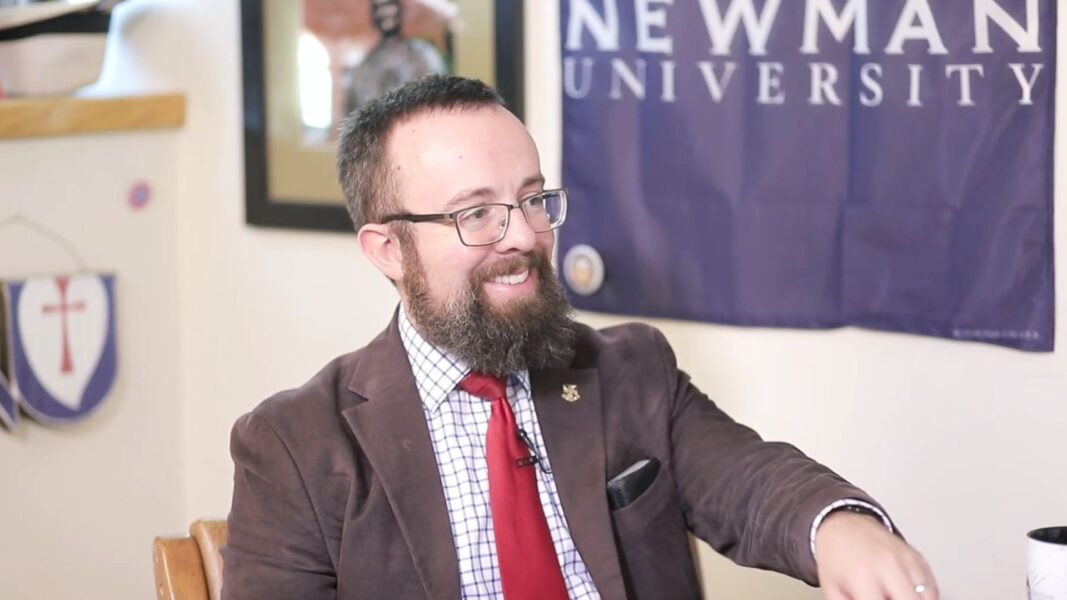
Adapting teaching methods (12:13–14:03)
Brungardt adapts his teaching by introducing oral exams and maintaining traditional writing assignments to better prepare students for seminary rigor.
Introducing ‘Natural Philosophy: An Introduction’ (14:03–17:25)
His book “Natural Philosophy: An Introduction,” published through the Encyclopedia of Catholic Theology, serves seminarians and educators by explaining how philosophy underpins theology. A video version is available on ect.org.
What is natural philosophy? (17:50–22:45)
Brungardt defines natural philosophy as the study of nature and the cosmos before modern science — asking foundational questions about how the universe works. He connects it to metaphysics, ethics and human self-knowledge.
Contrasting natural philosophy and modern science (23:18–27:30)
He contrasts natural philosophy’s respect for nature with the modern tendency to dominate it through technology, tracing this shift to early modern philosophers like Descartes and Bacon, who sought to “master” nature.
Humanity as the bridge between creation and the divine (27:53–35:53)
Brungardt emphasizes that natural philosophy reveals humans as “microcosms” of creation, forming a bridge between the natural and divine. He links this understanding to Catholic education’s mission of forming students intellectually, ethically and spiritually.
‘The Newman Bond’ podcast
Watch full episodes of “The Newman Bond” podcast on YouTube or listen on Spotify or Apple Podcasts.