As the Easter season moves into its sixth week, the Newman University community continues its tradition of daily Scripture reflections, drawing wisdom from the Acts of the Apostles and the Gospel of John. Contributors this week — ranging from students and staff to a transitional deacon and a friend of the university — explore the transformative presence of the Holy Spirit, the call to courage amid hardship and the reassuring promise that we are never alone.
From Sister Rose McKeown’s meditation on Jesus’ vow to “not leave you orphans” to a student’s reminder that God sees the full picture of who we are, this week’s reflections weave together a tapestry of hope, faithfulness and trust. Together, they call us to remain attentive, respond with courage when the moment comes and hold fast to the joy that Christ promises awaits us.
May 10, Sixth Sunday of Easter
Acts 8:5-8, 14-17; 1 Pt 3:15-1; John 14:15-21
Sister Rose McKeown, ASC
In today’s Gospel, we see Jesus feeling the grief of his disciples as he talks about leaving them. He responds to that grief. Jesus promises them and us the gift of the Holy Spirit: “I will not leave you orphans; I will come to you.”
We don’t have to live two thousand years ago to know Jesus. The Holy Spirit brings Jesus to us and convinces us from within of who Jesus is for us. God dwells within the human heart. We are never alone. We have a Helper, an Advocate. That same Spirit who came upon the apostles lives now within each of us. That same Spirit sends us forth to live the Good News of God’s love and forgiveness.
May we love one another! And, may you “always be ready to give an explanation to anyone who asks you for a reason for your hope!”
May 11, Monday of the Sixth Week of Easter
Acts 16:11-15; John 15:26 -16:4a
Tiffany Webster, Director of Outreach Education, Western Kansas Program
These readings remind us that faith often looks quiet but requires real responsiveness. Lydia is simply open, and when her heart is stirred, she acts without hesitation. Her faith becomes hospitality and action. In John, Jesus is honest that following Him will not be easy, but we are not left alone; the Spirit guides and strengthens. Together, these passages challenge us to stay attentive, to trust that God is already at work, and to respond with courage when the moment comes.
May 12, Tuesday of the Sixth Week
Acts 16:22-34; John 16:5-11
Mary Kate McClure, Student
Both readings for today reveal how God works through hardship to bring transformation. In Acts, Paul and Silas suffer unjustly, but their faith leads to conversion and salvation for the jailer and his household. In John, Jesus explains that his departure will bring the Holy Spirit, who convicts the world and also reveals truth. Both passages show that suffering and change are not meaningless but provide the opportunity for deeper faith and understanding. The presence of God turns fear into hope, using difficult moments to draw people closer by revealing his power, mercy, and purpose in unexpected ways.
May 13, Wednesday of the Sixth Week of Easter
Acts 17:15, 22—18:1; John 16:12-15
Rev. Mr. Jacob McGuire ’22, Transitional Deacon
As shown in the first reading, God has created the world in a way that reveals signs of Himself, an ordering that helps lead people to the God that their hearts long to worship. St. Paul sees as much with the Greeks’ altar to an Unknown God; as if they’re worried they still don’t understand the divine. But we also see how people were divided over the resurrection; a division that still can cause frustration with evangelization today. We must not give into despair but instead pray that the Holy Spirit will help them understand as he has helped us.
May 14, Feast of Saint Matthias, Apostle
Acts 1:15-17, 20-26 ; John 15:9-17
Aaron Ryder, Director of Facilities
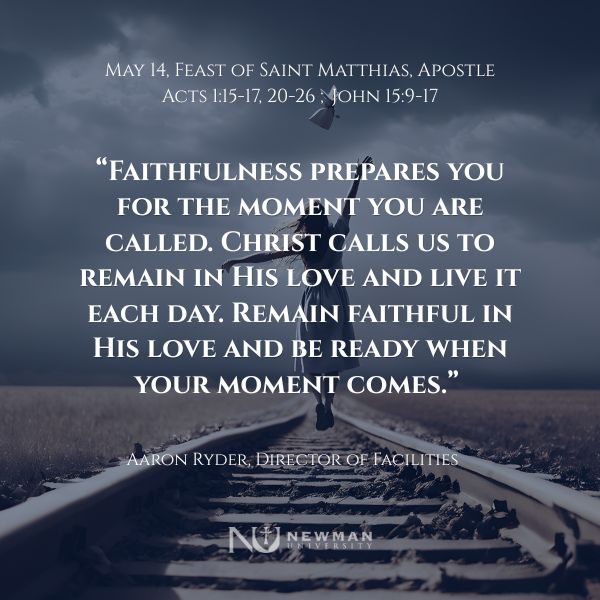
Matthias stepped forward at a decisive moment in the life of the Church. He had followed Christ from the beginning and stayed when others walked away. When the time came, he was chosen to replace Judas. Faithfulness prepares you for the moment you are called. Christ calls us to remain in his love and live it each day. Matthias had done exactly that. When we remain in his love, we are formed for what lies ahead. Like Matthias, we must decide if we are willing to act. Remain faithful in his love and be ready when your moment comes.
May 15, Friday of the Sixth Week of Easter
Acts 18:9-18; John 16:20-23
J. Basil Dannebohm, Friend
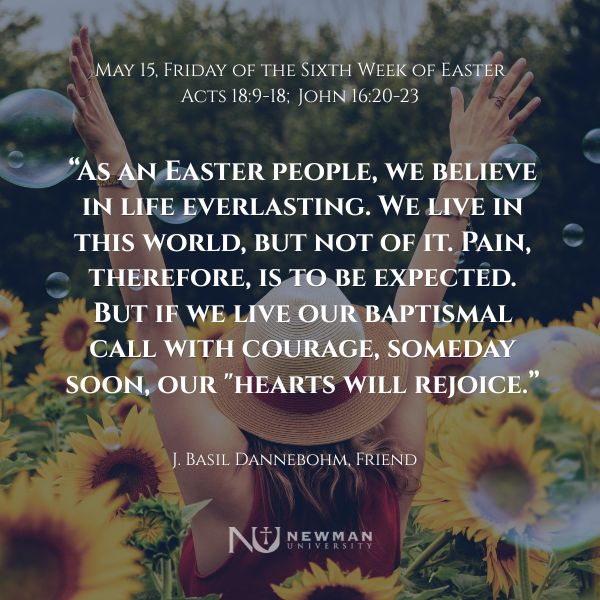
“Do not be afraid” were the first words Christ spoke to the women at the tomb, exactly 40 days ago on Easter. At this 40-day milestone, it’s fitting that the reading from Acts reinforces our Lord’s command, this time to St. Paul. Today’s gospel goes further, reminding us we “will weep and mourn, while the world rejoices.” As an Easter people, we believe in life everlasting. We live in this world, but not of it. Pain, therefore, is to be expected. But if we live our baptismal call with courage, someday soon, our “hearts will rejoice.”
May 16, Saturday of the Sixth Week of Easter
Acts 18:23-28; John 16:23b-28
Joseph Luebbe, Student
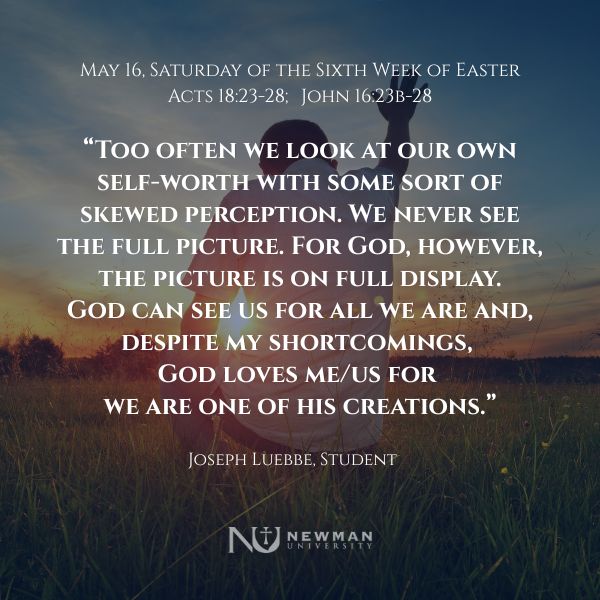
God is capable of a great many things. He multiplied a meager amount of fish and bread to feed 5,000, raised people from the dead and he can split the ocean in two. We have faith that God did and can do this; it is just as important that we have faith in ourselves. We must believe we can achieve great things. Too often, we look at our own self-worth with some sort of skewed perception. We never see the full picture. For God, however, the picture is on full display. God can see us for all we are and, despite my shortcomings, God loves me/us for we are one of his creations.