Newman University’s nurse anesthesia program has recently earned continued accreditation from the Council on Accreditation of Nurse Anesthesia Educational Programs (COA).
The COA is the national body that has set the bar for nurse anesthesia education across the United States and Puerto Rico for the past 50 years. The four-year renewal took effect June 3, 2026, and carries the program forward to its next scheduled review in spring 2030.
For a program that has served Wichita and the surrounding region for decades — and four years ago made the significant leap from a master’s degree to a clinical doctorate — the decision is more than a line on a website.

“We were excited because this validates our program, all our hard work and time — ultimately what we’re doing to graduate safe anesthesia providers,” said Kimyatta Brent, DNP, MSN, CRNA, who serves as program administrator for the Doctor of Nurse Anesthesia Practice (DNAP) program. “But being competitive, it has lit a fire under us to continually challenge ourselves so we can achieve higher the next time around.”
What accreditation actually means
Accreditation can sound like bureaucratic housekeeping. Brent described it as something closer to a promise — one that means different things to different people.
“It’s an official seal of approval signifying a program meets high educational standards,” she said. For students, she explained, it guarantees a high-quality education. Graduates of the program become certified registered nurse anesthetists, or CRNAs. For patients, it offers assurance that their anesthesia provider was safely trained. For the university, it’s a mechanism that keeps the program current. And for employers, it verifies that a job applicant has the skills to deliver anesthesia safely.
The COA is a specialized accreditor recognized by the U.S. Department of Education. Newman’s nurse anesthesia program is one of two nurse anesthesia programs in the state and is based in Wichita. It also holds accreditation through the Higher Learning Commission and approval from the Kansas State Board of Nursing.
A first-of-its-kind review
This renewal marked a milestone the program had been building toward for years. The last time the COA conducted an on-site review, Newman had not yet transitioned from a master’s-level program to a doctoral one. The move wasn’t optional: since Jan. 1, 2022, the COA has required students entering nurse anesthesia programs to be enrolled in an accredited doctoral degree program. The Doctor of Nurse Anesthesia Practice is a clinical doctorate, the credential now required to enter the profession.
“This was years in the making, with lots of paperwork and evaluations,” Brent said. At the center of it all sits the self-study — a detailed account of how the university and program meet the standards the COA sets.
Those standards number more than 150. For each one, the program must provide a written narrative and supporting documentation showing it is doing what it says it is doing — and, where it falls short, explaining why and laying out a plan to address it.
“It’s really an all-hands-on-deck process, in addition to maintaining and juggling our regular workloads,” Brent said. “It’s a check and balance, if you will, that ensures we are providing a high-quality education and not only meeting but, in some aspects, surpassing the standards.”
What the review affirmed
When the results came back, three strengths stood out: the curriculum, the program’s clinical instruction and experiences and its faculty leadership team.

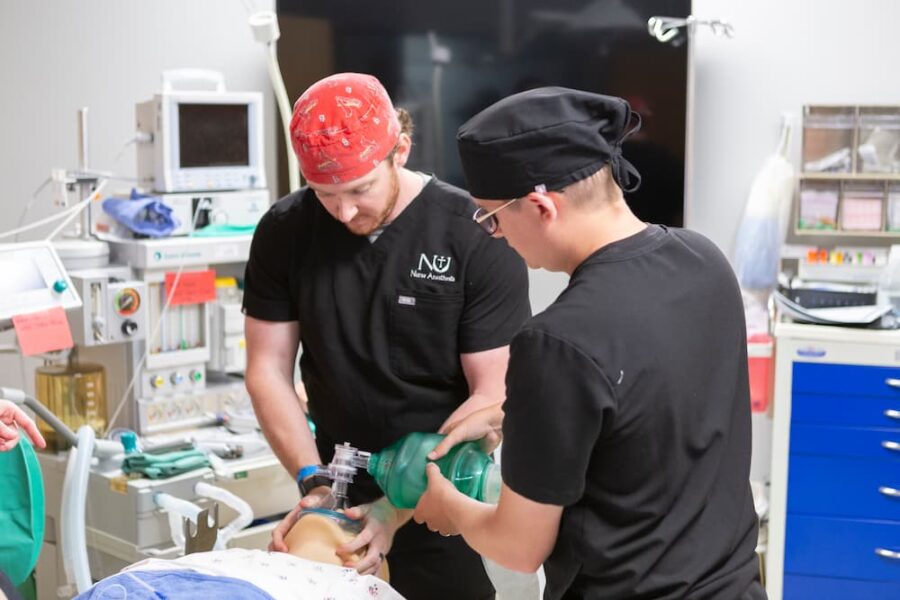
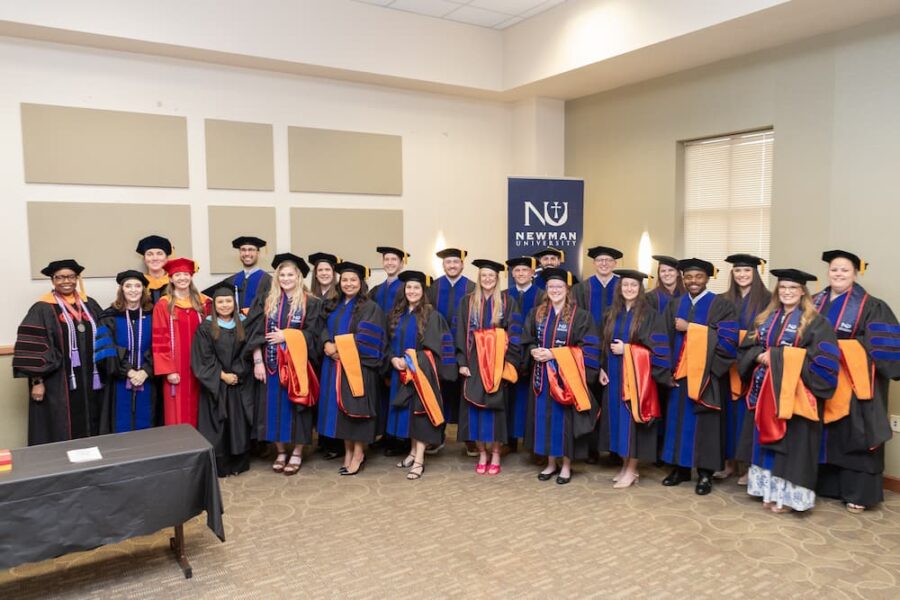
Those strengths show up in the numbers. The DNAP is a 36-month, 88-credit-hour program that pairs classroom instruction at Newman with clinical rotations at hospitals across the region and a primary site in Oklahoma City. The class of 2026 — 18 graduates — posted an 83% first-time pass rate on the National Certifying Exam (NCE), climbing to 94% within 60 days, with attrition held to 5%.
The most telling figure may be employment: every member of the class was working within six months. And most did not go far. Ten of the 18 took positions across Kansas — six of them in Wichita, at anesthesia groups including Mid-Continental Anesthesiology Chartered and Anesthesia Consulting Services — with others settling in Pratt, Salina, Topeka and Hutchinson. Five joined practices in Oklahoma, and the rest headed to Tennessee and Oregon.
That regional concentration is central to how Brent frames the program’s purpose — the graduates Newman trains are, in large part, the anesthesia providers who go on to staff the communities around it.
The road to spring 2030
The COA’s decision included a required progress report tied to graduate, curriculum and evaluation standards — language that can sound alarming to an outside reader but that Brent frames as routine. Those are simply among the benchmarks the program must consistently meet, and often exceed, to stay compliant.
She sees the entire process as a tool rather than a test.
“It helps by assisting us with identifying any potential problems or shortcomings that we may have missed, or that could become a problem if not addressed,” Brent said. “It is truly a check and balance that we can measure ourselves against continuously.”
That mindset shapes the goals she has set for the next four years: refine what works, sustain the program’s strong outcomes and keep raising the ceiling.
“Our programmatic outcomes have been strong, and we want to maintain and sustain those,” Brent said. “It is outward evidence to all that we are doing the job we set out to do at Newman — and that our graduates truly are set to transform society.”
For Brent, that last phrase — drawn from Newman University’s mission — is not abstract. The people who complete this program go on to care for patients in their most vulnerable moments.
“These are the anesthesia providers who serve our communities and will one day possibly take care of us and our loved ones,” she said. “Knowing they are a Newman graduate provides a certain level of comfort, because we know the rigor and commitment required to be successful in such a program.”
Class of 2026
All 18 graduates were employed within six months. A snapshot of where they went to work:
Kansas
- Brittany Grabill — Mid-Continental Anesthesiology Chartered (Wichita)
- Sarah Graham — Anesthesia Consulting Services (Wichita)
- Shelbi Hayter — Anesthesia Consulting Services (Wichita)
- Kaitlyn McLeod — Wichita Anesthesiology Chartered (Wichita)
- Valerie Osborn — Wichita Anesthesiology Chartered (Wichita)
- Sarah Somers — Anesthesia Consulting Services (Wichita)
- Abderrahman Khamis — Pratt Regional (Pratt)
- Karla Romero Garcia — Stormont Vail (Topeka)
- Nicholas Wiens — Salina Regional (Salina)
- Cecilia Winters — Hutchinson Regional (Hutchinson)
Oklahoma
- Alison Harp — Ascension St. John (Tulsa)
- Fatima Lambert — Norman Regional (Norman)
- Jonathan Rodery — Norman Regional (Norman)
- Justin Rogers — Stillwater Medical Center (Stillwater)
- Brett Taylor — Ascension St. John (Jenks)
Tennessee
- Brittney Burba — University of Tennessee (Knoxville)
- Christopher Scott — Vanderbilt (Nashville)
Oregon
- Brian Hayes — Grande Ronde Hospital (La Grande)
Newman DNAP Program
The DNAP application cycle opens June 1 and closes August 31 for the following summer cohort.