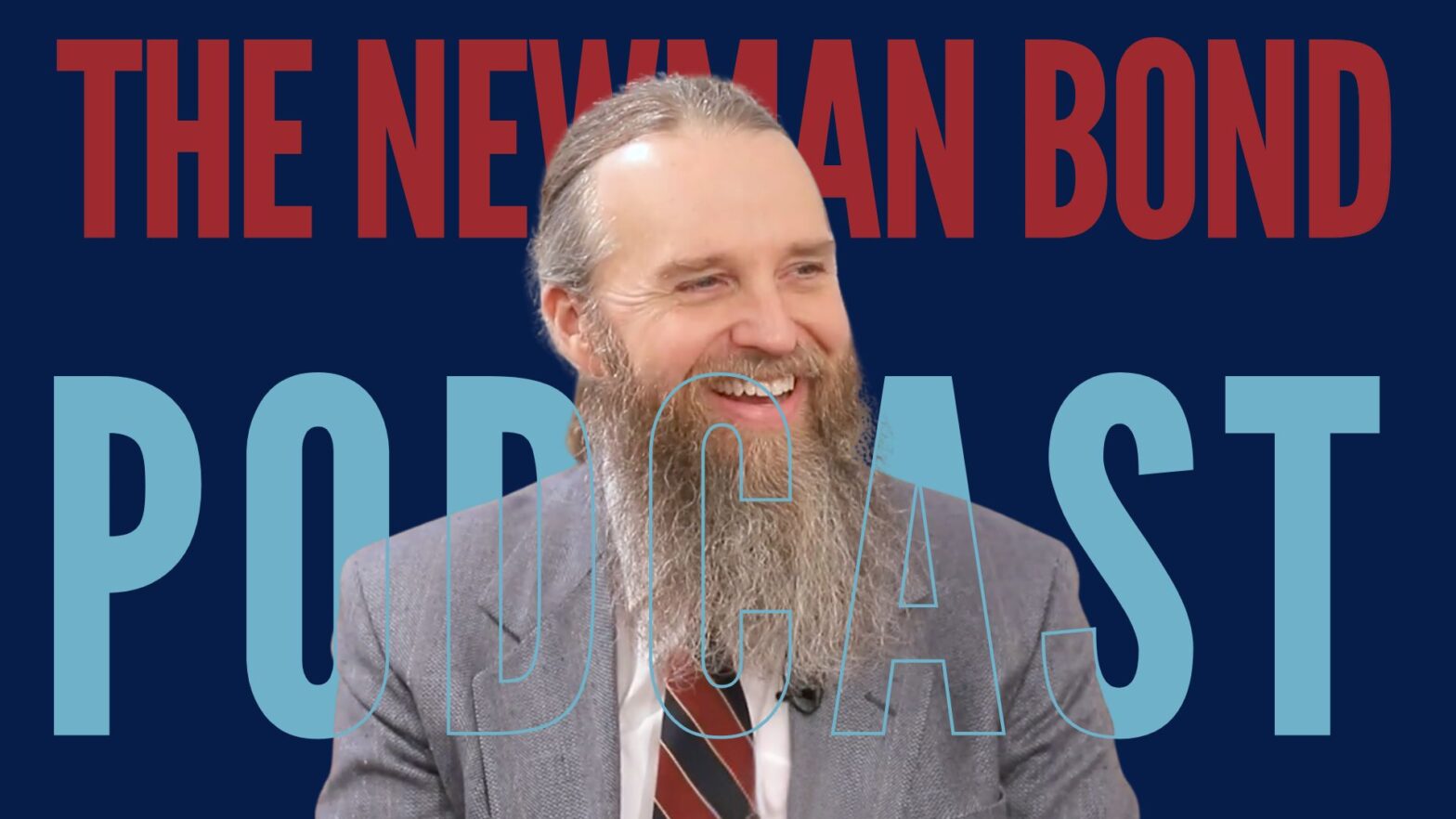
On this episode of “The Newman Bond” podcast, student Cory Buchanan interviews Associate Professor of Theology Matthew Umbarger about his newly published book, “A Table in the Presence of My Enemies” and the deeper meaning behind Psalm 23.
Umbarger explains how ancient Near Eastern covenant and pre-battle banquet traditions illuminate the psalm’s imagery and enrich one’s understanding of scripture. Their conversation also explores the connection to the Eucharist and how readers can better interpret biblical texts through the author’s intended meaning.
Overview of conversation topics
Read on to skim or find timestamps of specific topics covered in this episode.

Introduction and background (0:00-0:42)
Umbarger introduces himself as an Old Testament theologian and explains that his book began as his dissertation while living in Israel.
Discovery of the pre-battle banquet motif (1:40–2:34)
He became interested in the “pre-battle banquet motif” — the pattern in ancient literature and mythology where a feast precedes combat — and noticed resonances between it and certain biblical texts, particularly Psalm 23.
Interpreting “A Table in the Presence of My Enemies” (2:34–3:17)
Upon encountering the verse “a table in the presence of my enemies,” Umbarger realized this phrase is rarely unpacked deeply, and began mining ancient commentary to understand its meaning beyond modern familiarity.
Rethinking the table as covenant, not triumph (3:53–4:40)
He argues that rather than boastful triumph — as some, including C. S. Lewis, have interpreted — the “table” should be seen as a covenant-style banquet that prepares the believer for spiritual battle, giving sustenance and strength.
Ancient Near Eastern covenant meals (6:19–7:16)
Umbarger explains that in the ancient Near East, covenants were often sealed with blood sacrifices and followed by shared meals — a cultural context often lost to modern readers. In that world, sharing a meal signified deep intimacy and inclusion.
Fulfillment in the Eucharist (11:39–13:01)
When reframed in Christian theology, Umbarger sees the “banquet motif” fulfilled in the Eucharist: the Eucharistic table serves as the “pre-battle banquet” that gives spiritual nourishment to face life’s struggles.
Biblical banquets as covenant moments (19:32–20:19)
He connects the banquet imagery to biblical narratives such as the feast at Mount Sinai (after the law was given), suggesting that these feast scenes draw from ancient covenantal practices to symbolize communion with God.
Literal vs. spiritual sense of scripture (31:29–35:08)
Umbarger distinguishes between the literal meaning of scripture and its deeper spiritual sense: First, one must discern what the human author intended, then — drawing on tradition — see how the deeper or spiritual sense might apply.
Example of Psalm 22’s expanded Christian meaning (36:00–37:44)
He discusses how a psalm like Psalm 22 can be read in light of later Christian events — not contradicting its original meaning, but expanding its significance through the inspiration of the Holy Spirit.
‘The Newman Bond’ podcast
Watch full episodes of “The Newman Bond” podcast on YouTube or listen on Spotify or Apple Podcasts.